↑ Back to topYard signs look simple.
A rectangle. A stake. A logo. Done.
But behind that simple format are decisions that affect visibility, durability, cost, and performance — and most first-time buyers don’t realize those decisions matter until after the order is placed.
The size determines whether your message can be read from the street.
The material determines whether it survives the season.
The artwork determines whether it looks professional or improvised.
And the installation determines whether it stands straight or leans by day three.
Yard signs are designed to be temporary — but the impression they create is not.
Whether you’re promoting a listing, advertising a completed job, celebrating a graduate, or directing traffic to an event, the right sign works quietly and efficiently. The wrong one wastes money and disappears into the background.
This guide breaks down what actually matters:
the standard sizes, the materials, the production details, and the common mistakes that make the difference between a sign that performs and one that doesn’t.
If you’ve ever thought, “It’s just a yard sign,” this is where you find out what that really means.
↑ Back to top
What a Yard Sign Actually Is
A yard sign is classified as temporary signage — but that doesn’t mean it’s disposable or insignificant.
It’s designed to deliver a clear message in outdoor conditions, at a distance, for a defined period of time. That period might be a weekend event, a 30-day real estate listing, a multi-month contractor project, or an entire campaign season. The lifespan varies. The purpose does not.
A yard sign’s job is visibility.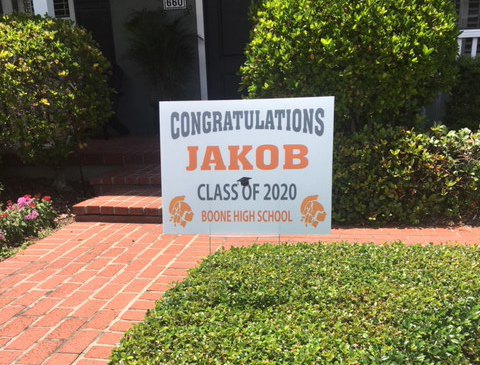
It has to compete with grass, landscaping, parked cars, traffic movement, weather, and visual noise. It doesn’t get lighting. It doesn’t get elevation. It doesn’t get architectural framing. It earns attention through size, contrast, placement, and clarity alone.
That’s why material, structure, and layout matter more than most buyers expect.
Unlike permanent signage — monument signs, post-and-panel systems, building-mounted signs — yard signs are built for mobility. They are lightweight by design. They install without heavy equipment. They can be repositioned easily. And they’re cost-efficient enough to produce in volume.
But “lightweight” does not mean fragile.
The industry standard material, corrugated plastic, is engineered to handle outdoor exposure while remaining easy to transport and install. The fluted core provides rigidity without unnecessary weight, which is why it dominates the temporary signage category.
Yard signs are commonly used for:
- Real estate listings
- Contractor job site advertising
- Political campaigns
- School and graduation announcements
- Event direction and promotion
- Community and HOA messaging
In each case, the sign serves the same function:
Deliver a message quickly, clearly, and affordably — in an uncontrolled outdoor environment.
When done correctly, a yard sign works quietly and efficiently.
When done poorly, it blends into the lawn and is forgotten before anyone reads it.
Understanding what the sign is designed to do makes every decision that follows — size, material, layout, installation — easier and more strategic.
↑ Back to top
Why 18×24 Became the Industry Standard
If you look around any neighborhood, you’ll notice a pattern.
Most yard signs are 18 inches tall by 24 inches wide.
That isn’t an accident.
The 18×24 format became the industry standard because it balances three things extremely well: visibility, structural stability, and production efficiency.
Visibility
At typical residential road speeds, a sign must be readable from approximately 25 to 50 feet away. An 18×24 layout provides enough surface area for a bold headline, a logo, and a readable phone number without forcing text to shrink beyond legibility.
Go smaller, and the message becomes compressed.
Go larger, and costs increase while installation becomes less practical for standard stakes.
Eighteen by twenty-four sits in the sweet spot.
Structural Compatibility
Standard H-stakes are designed with this size in mind. The vertical flute direction of corrugated plastic allows the stake to slide securely into the sign panel, creating stability without additional hardware.
That compatibility matters. A size that works seamlessly with standard support hardware reduces install issues and keeps the sign upright in normal wind conditions.
Production Efficiency
This is the part most buyers never see.
Corrugated plastic sheets are manufactured in large formats. An 18×24 layout allows print shops to maximize material yield when cutting multiple signs from a full sheet. That efficiency lowers waste, improves turnaround time, and helps keep pricing consistent.
It’s not just about what looks good in a yard.
It’s about what runs efficiently through production.
That’s why 18×24 dominates real estate, contractor advertising, political signage, and event promotion. It’s not trendy. It’s practical.
Of course, there are situations where alternative sizes make sense — directional signs may run smaller, and larger properties sometimes benefit from oversized panels — but when in doubt, 18×24 remains the most balanced starting point.
There’s a reason professionals default to it.
↑ Back to top
Materials Explained: What Yard Signs Are Made Of (And Why It Matters)
When most people think of a yard sign, they think of “plastic.”
That’s technically true — but not specific enough to be useful.
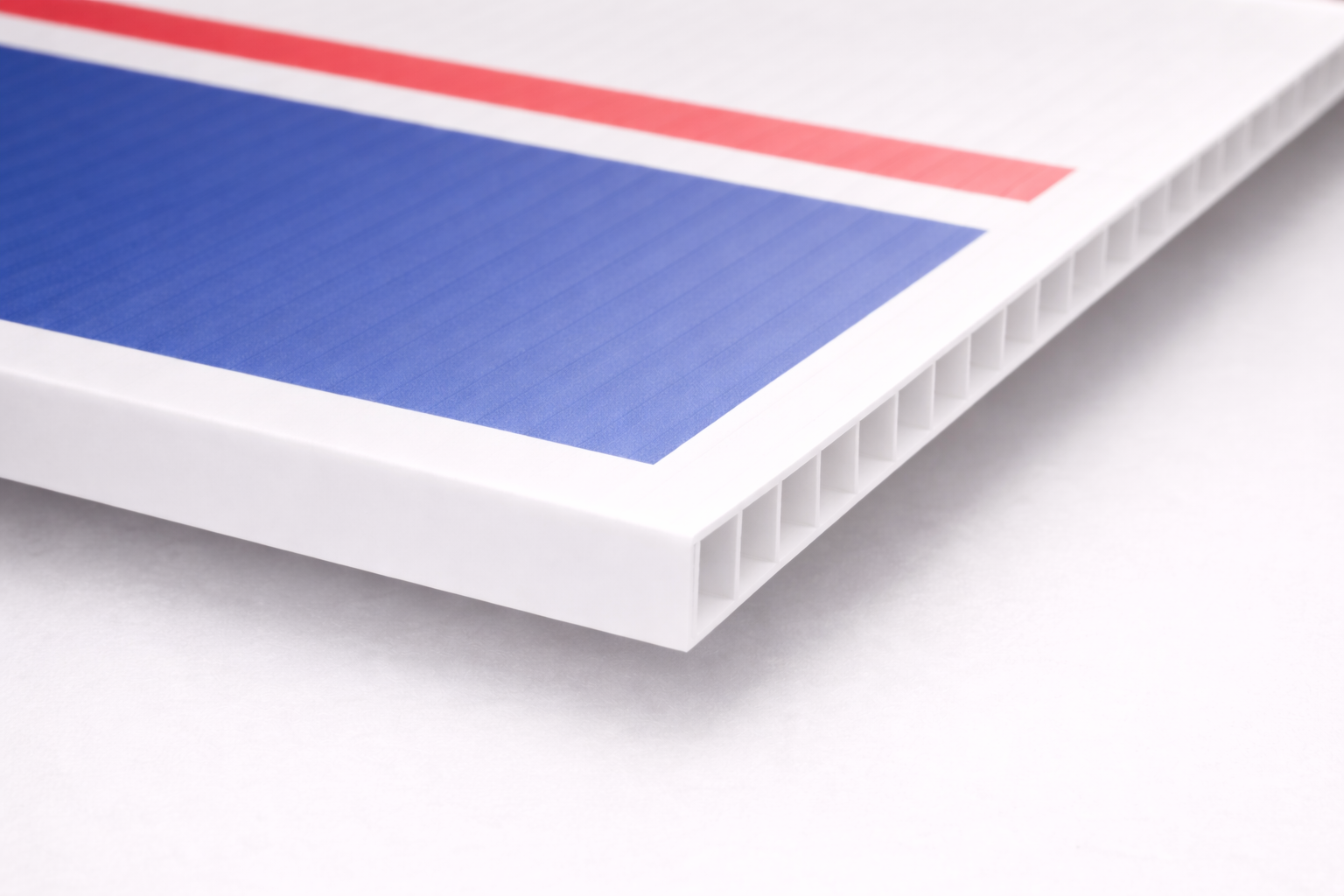
Corrugated plastic structure showing internal flutes that provide strength and allow H-stake installation.
The industry standard material for yard signs is corrugated plastic, often referred to as coroplast. It’s not solid plastic. It’s engineered with a fluted core — two flat outer layers connected by vertical ribs that create channels through the center.
That structure is what gives the material its strength.
Why Corrugated Plastic Works
The fluted interior provides rigidity without adding unnecessary weight. That means the panel stays firm in normal wind conditions while remaining lightweight enough to install by hand.
It also offers:
- Water resistance
- UV tolerance for short- to mid-term exposure
- Impact flexibility (it bends before it snaps)
- Cost efficiency for volume production
This combination is what makes it ideal for temporary outdoor signage.
A solid plastic panel would be heavier and more expensive.
Cardboard would fail at the first rainstorm.
Corrugated plastic sits exactly where it needs to.
Flute Direction Matters
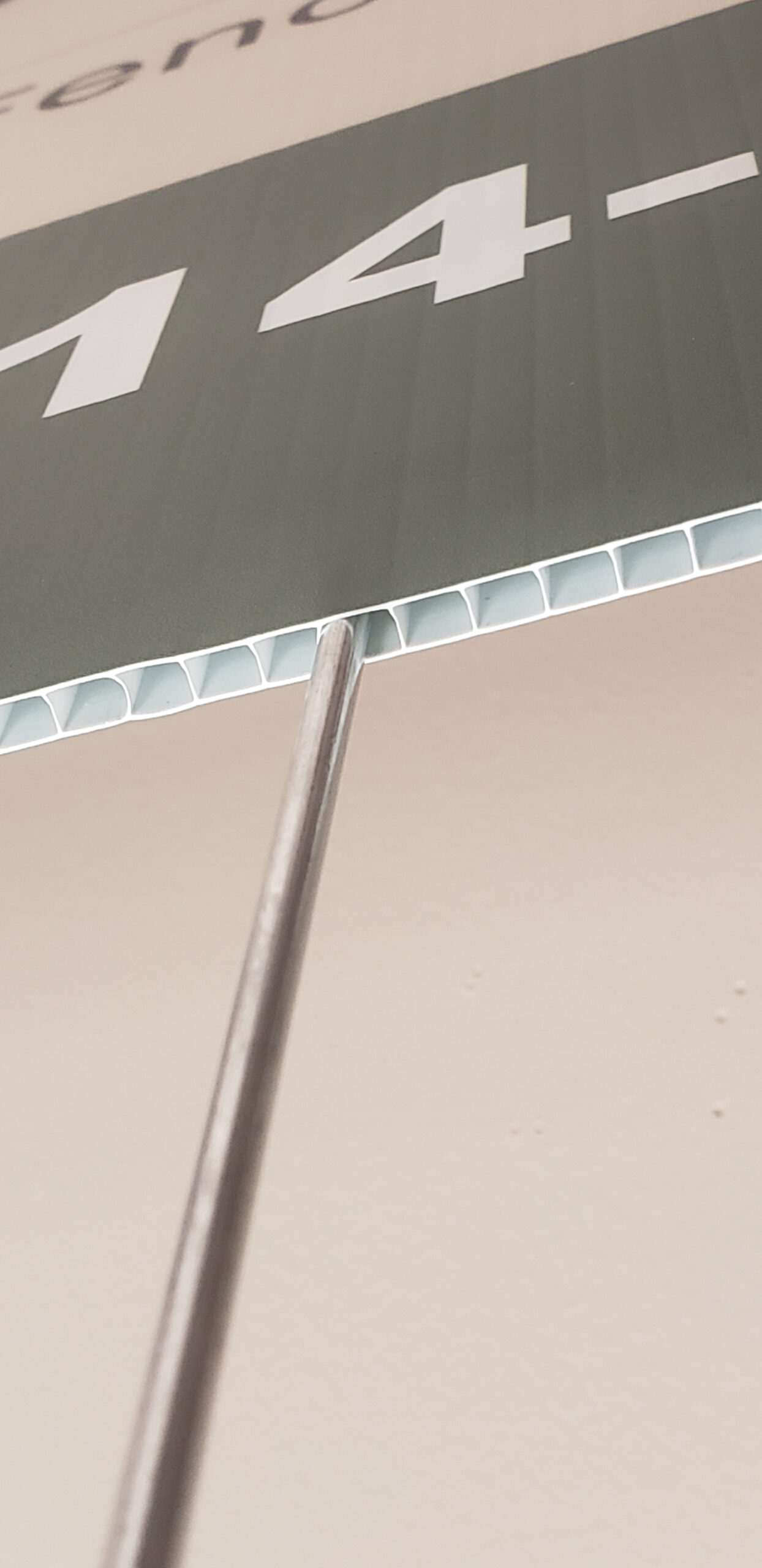
Insert the 9 gauge wire into the open flute channel of the corrugated plastic sign until fully seated.
↑ Back to top
This is something beginners rarely consider.
The internal channels of corrugated plastic run in one direction. For standard yard sign installation using H-stakes, those flutes must run vertically so the stake wires can slide into the channels and hold the sign securely.
If the flute direction is incorrect, installation becomes unstable or impossible without additional hardware.
It’s a small detail — but it determines whether the sign stands properly.
When Other Materials Make Sense
There are situations where aluminum or thicker substrates are used. These are typically reserved for longer-term installations or areas with heavier wind exposure.
But for real estate listings, contractor advertising, graduation announcements, political campaigns, and short-term events, corrugated plastic remains the most efficient and practical choice.
It was designed for this category.
Understanding the material helps explain why yard signs perform the way they do — and why cutting corners on substrate quality almost always shows up in the field.
Single-Sided vs. Double-Sided: What Actually Changes
At first glance, the choice seems simple.
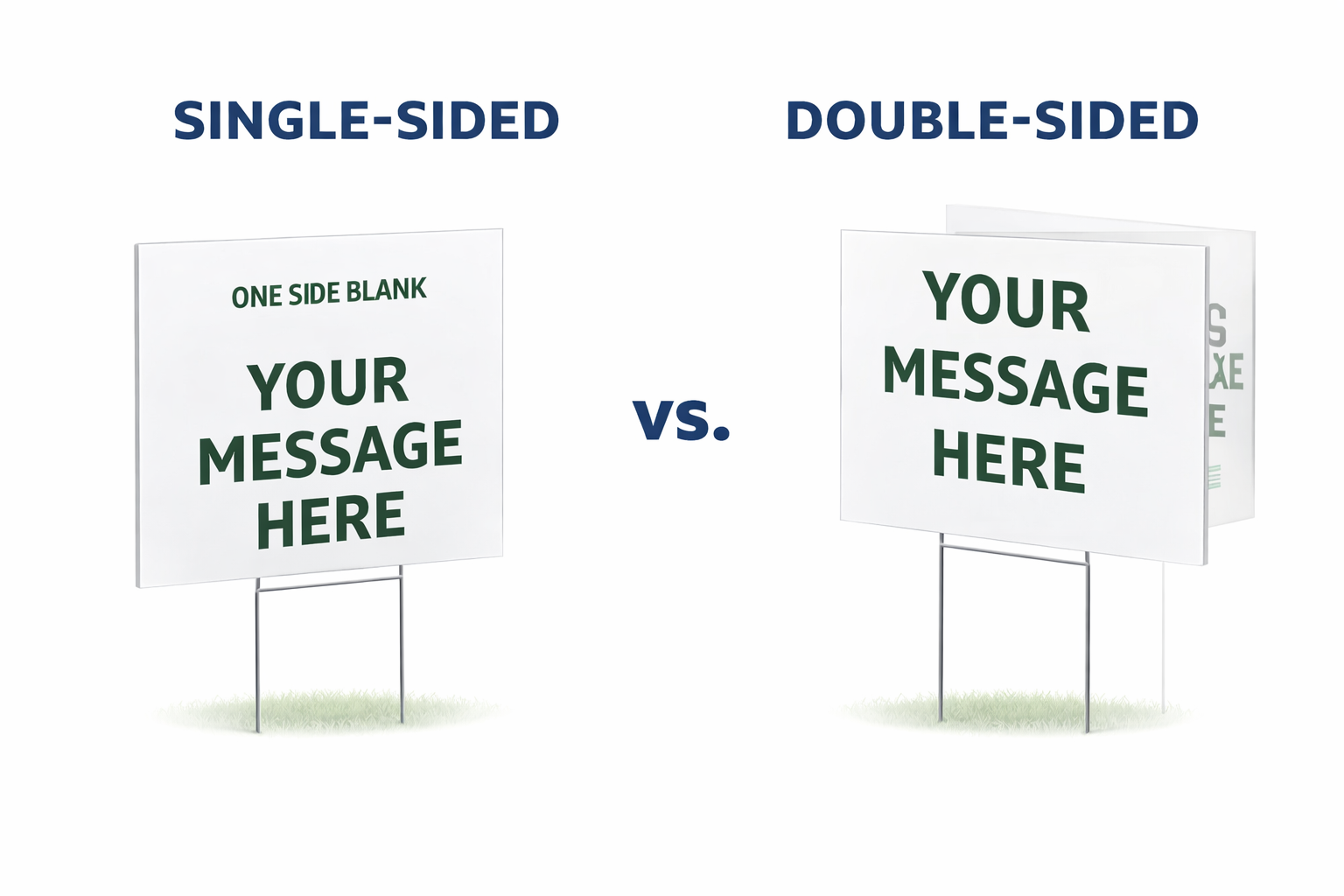
Single-sided vs. double-sided yard sign comparison showing visibility from one or both directions.
Do you want printing on one side or both?
But the difference isn’t just about “more ink.” It’s about visibility, placement strategy, and how the sign interacts with its environment.
How Single-Sided Signs Work
A single-sided yard sign is printed on one face of the panel. The reverse side is blank.
This works well when:
- The sign is placed against a fence or building
- It’s positioned along a one-directional traffic flow
- The message only needs to face a primary viewing angle
Single-sided signs are slightly more economical, and in the right placement, they perform just as effectively as double-sided panels.
The key phrase there is in the right placement.
↑ Back to top
What Double-Sided Really Means
A double-sided yard sign has printing on both faces of the same panel.
That matters because most yard signs are installed in open lawns, near streets where traffic flows in both directions. A double-sided layout ensures the message is visible regardless of approach.
If your audience can pass from either side, single-sided signs cut your exposure in half.
That’s not a design issue — it’s a visibility issue.
It’s Not Always “Double the Cost”
Another common misconception is that double-sided printing means doubling the expense.
In reality, the substrate remains the same panel. The difference is the additional print pass and ink coverage. While there is an added cost, it is not the same as ordering two separate signs.
For high-traffic placements, double-sided signs often provide better return on investment because they maximize exposure without increasing footprint.
Placement Should Drive the Decision
The best way to decide between single and double-sided isn’t by defaulting to the cheaper option. It’s by asking:
- Will viewers approach from both directions?
- Is the sign placed in open space?
- Is visibility critical from multiple angles?
If the answer is yes, double-sided is usually the smarter choice.
If placement is controlled and directional, single-sided can perform just as well.
The decision isn’t about preference.
It’s about strategy.
Stakes & Installation: The Part That Determines Whether It Stays Standing
A yard sign can be perfectly designed, printed at high resolution, and cut cleanly — and still fail if it isn’t installed correctly.
Support hardware isn’t an accessory. It’s structural.
The Standard: H-Stakes
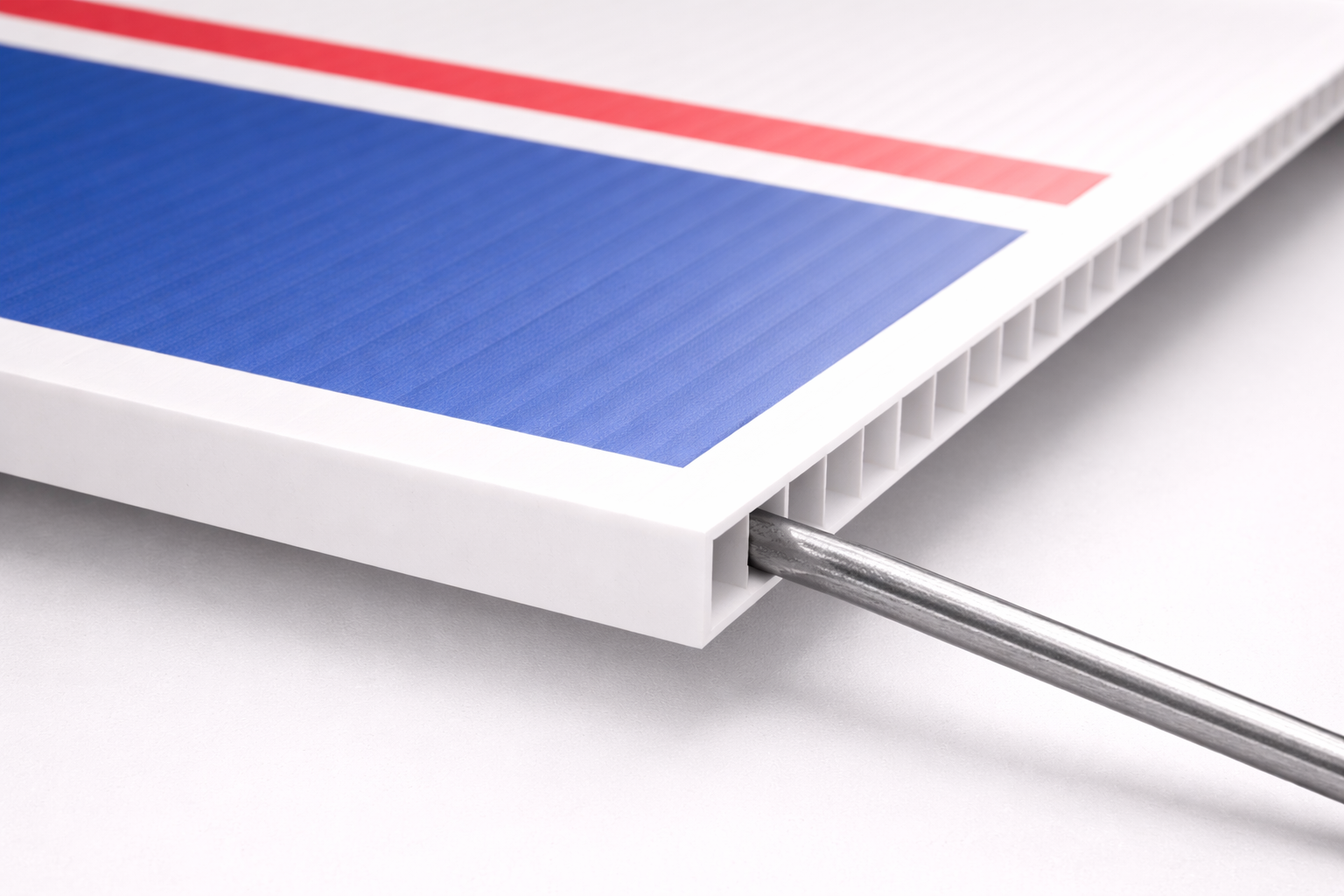
Galvanized wire inserted into the internal flute of corrugated plastic, demonstrating proper yard sign stake placement.
Most 18×24 yard signs are installed using wire H-stakes. The two vertical prongs slide directly into the fluted channels of the corrugated plastic, while the lower portion anchors into the ground.
This system works because it’s simple.
- No tools required
- Quick installation
- Easy repositioning
- Compatible with standard panel sizes
When installed properly — typically 6 to 10 inches into firm soil — an H-stake provides stable support in normal weather conditions.
The key is depth. If the stake isn’t seated far enough into the ground, even a mild wind can create movement.
Soil Conditions Matter
Not all lawns behave the same way.
Soft soil allows easy insertion but may require deeper anchoring. Dense or rocky ground can resist full stake penetration, which affects stability. In those cases, placement adjustments or alternative hardware may be necessary.
Installation isn’t complicated — but it does require attention.
Wind Exposure Is Real
Yard signs are lightweight by design. That’s part of their function.
But open lots, new developments, and rural areas often experience stronger wind exposure. In those environments, double-sided printing combined with proper stake depth becomes even more important for balance and resistance.
No temporary yard sign is designed to withstand extreme weather indefinitely. They’re built for practical outdoor performance — not hurricane conditions.
Other Mounting Options
While H-stakes dominate residential and short-term use, there are other mounting solutions available:
- Step stakes
- Metal frames
- Wood posts
- In-ground post-and-panel systems
These are typically used for longer-term installations or where a more permanent appearance is desired.
↑ Back to top
But for standard yard sign applications, the H-stake remains the most efficient and widely compatible solution.
A yard sign is only as effective as its installation.
It doesn’t matter how strong the message is if the sign is leaning by the third day.
Artwork & Design: Where Most First-Time Orders Go Wrong
Most yard sign problems don’t start in production.
They start in the file.
What looks clear and sharp on a laptop screen doesn’t always translate to a 24-inch panel viewed from across the street. Yard signs operate in real-world conditions — distance, motion, glare, uneven lighting — and artwork needs to account for that.
Resolution Matters More Than You Think
A common mistake is uploading a small logo pulled from a website or social media profile. On a screen, it looks fine. Enlarged to 18×24 inches, it becomes soft or pixelated.
For clean print results, artwork should be built at full size and at high resolution. As a general rule:
- Raster images should be 300 DPI at final size.
- Logos are best supplied as vector files (AI, EPS, or properly created PDFs).
Vector artwork scales without losing clarity. Raster images do not.
If a logo blurs when zoomed in on your screen, it will blur even more on a printed panel.
Readability Over Decoration
Yard signs are not brochures.
They have seconds to communicate.
From 30 feet away, viewers should be able to identify:
- Who you are
- What you’re offering
- How to contact you
That means prioritizing large, bold text and strong contrast. Thin fonts, script lettering, and excessive detail often disappear at distance.
A good rule of thumb: if you have to lean in to read it on your screen, it’s too small for a yard.
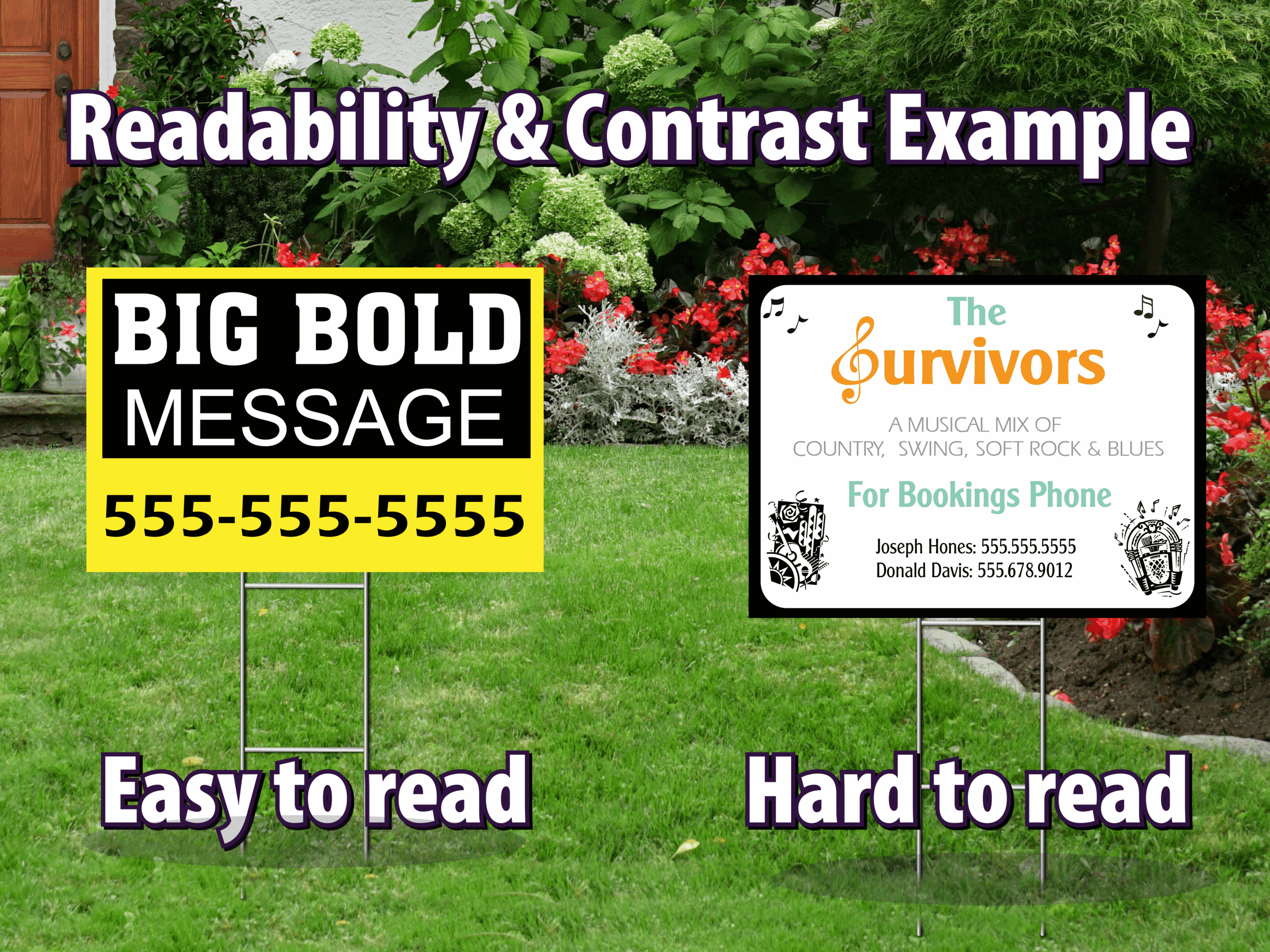
Clear, high-contrast yard sign design compared to a cluttered layout with reduced readability at distance.
Contrast Is Not Optional
Color combinations that look attractive on a monitor can fail outdoors.
Low-contrast pairings — light gray on white, red on dark green, navy on black — may look subtle up-close but lose impact in sunlight. Outdoor visibility demands clear separation between background and foreground.
High contrast equals legibility.
Subtlety rarely performs well in grass.
Simplicity Wins
Another common mistake is overcrowding the layout.
Multiple phone numbers. Taglines. Website URLs. Social icons. QR codes. Extra messaging.
The more information added, the smaller everything becomes.
A yard sign works best when it focuses on one primary objective. If viewers can’t process the message quickly, they won’t process it at all.
Proof Review Is Not a Formality
The proof stage exists to catch alignment issues, typos, scaling problems, and color balance before production begins.
Skipping careful proof review is one of the fastest ways to end up reordering.
The file you approve is the file that prints.
That’s not a warning — it’s simply how production works.
Strong design isn’t about decoration.
It’s about communication under pressure.
When artwork is built for distance, contrast, and clarity, the material and size decisions you’ve already made can do their job properly.
↑ Back to top
Common Beginner Mistakes (And How to Avoid Them)
By the time most people order yard signs a second time, they understand what works.
The goal is to get it right the first time.
Here are the most common issues we see — and how to avoid them.
1: Cramming Too Much Information
A yard sign is not a flyer.
When multiple messages compete for attention, none of them win. Prioritize one clear objective. Name, service, and contact. Everything else is secondary.
If it cannot be read in three seconds, it’s too busy.
2: Using Low-Resolution Artwork
Small web images enlarged to full size almost always degrade.
Before submitting artwork, zoom in. If edges look soft or pixelated on your screen, they will print that way.
Start with high-resolution files or vector logos whenever possible.
3: Ignoring Viewing Distance
Designing up close leads to mistakes.
Stand back from your screen. Can you still read the phone number? Is the headline bold enough? Thin fonts and fine details disappear outdoors.
Distance should guide font size and layout decisions.
4: Choosing Weak Color Contrast
Subtle color pairings often fail outside.
Bright daylight washes out light tones. Dark backgrounds swallow thin lettering. Strong contrast improves legibility instantly.
When in doubt, increase separation between background and text.
5: Treating Installation as an Afterthought
A well-designed sign installed poorly can lean, twist, or sit too low to be noticed.
Proper stake depth and thoughtful placement make a measurable difference in performance.
Yard signs are simple — but they are not accidental.
Most mistakes happen when decisions are rushed. A few minutes spent evaluating artwork, size, and placement usually prevents the need for a reprint.
And in temporary signage, avoiding a reprint is part of maximizing value.
↑ Back to top
How Long Yard Signs Last (And What Affects Their Lifespan)
Yard signs are built for temporary outdoor use — but “temporary” doesn’t mean fragile.
In typical conditions, a standard corrugated plastic yard sign can last anywhere from several weeks to several months. The exact lifespan depends on exposure, placement, and handling.
Sun Exposure
Direct sunlight gradually fades printed graphics over time. UV exposure affects darker colors differently than lighter ones, and high-contrast designs tend to maintain legibility longer as minor fading occurs.
For short-term promotions or seasonal use, fading is rarely an issue. For multi-month campaigns, it becomes a factor to consider.
Wind & Weather
Corrugated plastic handles rain without issue. It won’t absorb moisture like cardboard or swell in damp conditions.
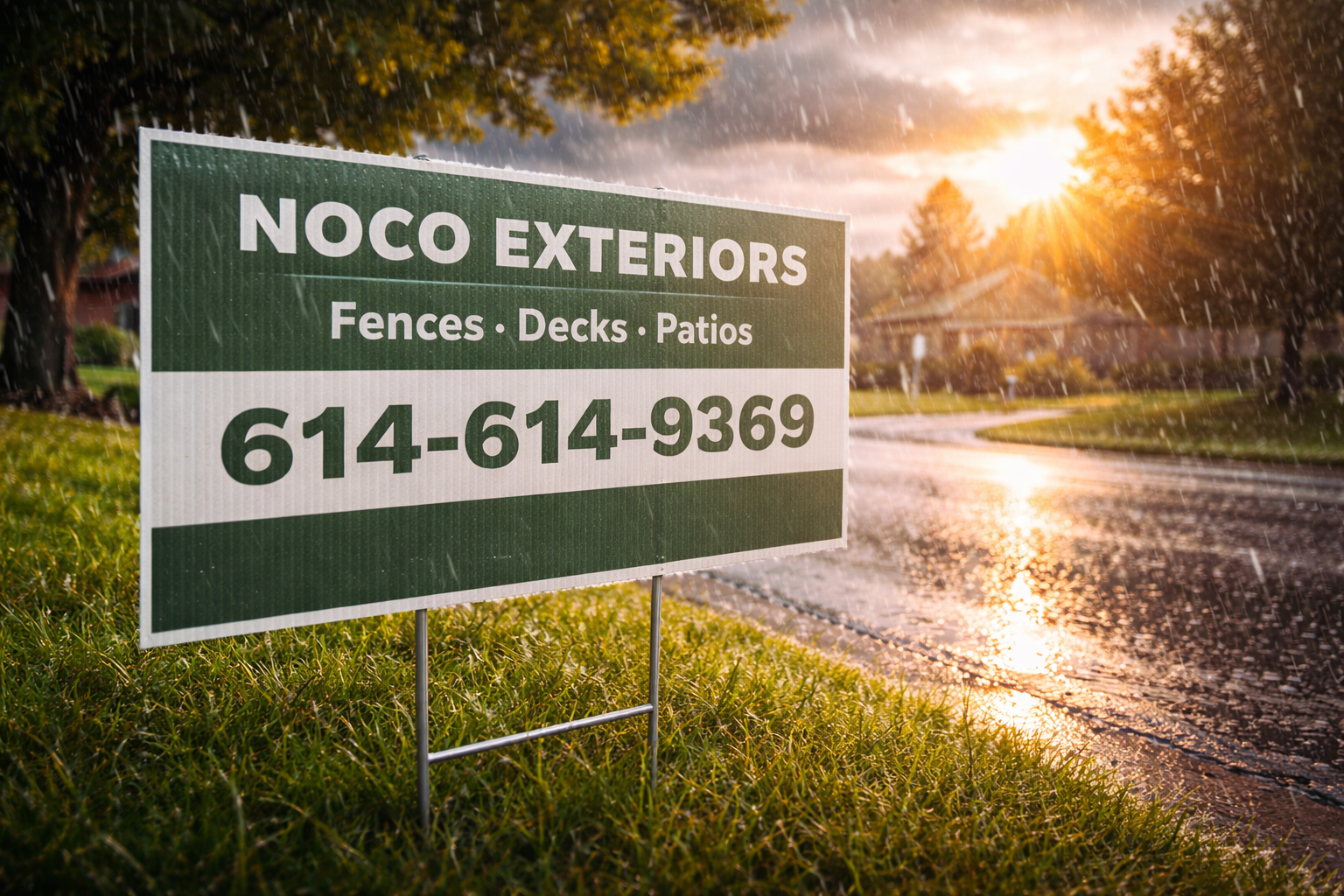
Corrugated plastic yard signs are designed to withstand rain and typical outdoor weather conditions when properly installed.
Wind is more variable.
In sheltered residential areas, properly installed signs remain stable. In open developments, rural properties, or lots without natural wind barriers, movement increases. Over time, repeated flexing can stress the panel around the stake entry points.
Proper installation depth reduces that risk significantly.
Ground Conditions
Signs installed in firm soil hold better than those placed in loose or sandy ground. Frequent repositioning can also weaken flute channels if handled roughly.
Temporary signage is designed for reasonable outdoor exposure — not indefinite installation.
Storage Matters
If signs are reused, storage makes a difference.
Stacking panels flat, keeping them dry, and avoiding prolonged pressure on edges helps preserve their shape and appearance. Leaving them exposed year-round, especially through winter conditions, shortens lifespan.
A yard sign’s job is to perform during the window it’s needed.
For real estate listings, contractor job sites, school events, or short campaign cycles, corrugated plastic delivers dependable outdoor durability at a cost that makes volume practical.
When the need becomes long-term or permanent, that’s when material upgrades and structural changes enter the conversation.
Which leads naturally to the next decision.
↑ Back to top
When It’s Time to Upgrade
Yard signs are designed to do one thing well: deliver a message clearly, quickly, and affordably in a temporary setting.
But there comes a point when temporary isn’t enough.
If your message needs to stay in place long-term…
If visibility needs to extend beyond lawn height…
If durability must withstand seasons, not weeks…
That’s when the conversation shifts.
Permanent signage — post-and-panel systems, monument signs, building-mounted signage — offers structural stability, elevated visibility, and long-term brand presence. The materials change. The installation changes. The investment changes.
The purpose changes too.
Temporary signage introduces.
Permanent signage establishes.
Knowing which category your project falls into is part of making the right decision from the beginning.
Simple Doesn’t Mean Thoughtless
Yard signs are straightforward.
They are not complicated pieces of engineering. They don’t require heavy equipment to install. They don’t involve architectural planning.
But they are strategic.
Size affects readability.
Material affects durability.
Artwork affects perception.
Installation affects performance.
Every one of those decisions influences whether the sign quietly does its job — or quietly disappears.
The difference between a sign that performs and one that doesn’t rarely comes down to cost. It comes down to understanding what matters before the order is placed.
That’s the advantage of asking the right questions.
If you’re ordering yard signs for the first time, now you know what to look for.
If you’ve ordered before and something didn’t work, you now know why.
Temporary signage may not stay in the ground forever. But when it’s done correctly, it leaves a lasting impression.
↑ Back to top
0 Comments