The Part Nobody Sees
There’s a moment every business owner loves.
The sign goes up.
The lights flip on.
And suddenly… the place feels real.
To everyone else, it looks simple—like the sign just appeared overnight.
But that moment?
It’s the final move in a much longer process.
Long before a sign is lifted into place, there are conversations, sketches, measurements, approvals, materials being cut, graphics being printed, and teams working behind the scenes to get every detail right.
Because a good sign isn’t just made.
It’s planned. It’s engineered. It’s built—step by step.
And once you see what actually goes into it…
you’ll never look at a sign the same way again.
The Initial Idea
Every sign starts the same way—

Every commercial sign starts with a simple need: to be seen.
with a realization.
Something isn’t working… or something new is about to begin.
It might be a business opening its doors for the first time, trying to make a strong first impression.
It might be a company rebranding, ready to show the world who they’ve become.
Or it could be more practical—
a location that’s being overlooked, a building that blends into the background, a sign that simply isn’t doing its job anymore.
Common triggers look like this:
- A new business opening that needs to announce itself
- A rebrand that requires a fresh visual identity
- A visibility problem where customers just aren’t finding the location
- A new location that needs to establish presence quickly
This is the spark.
The moment someone says, “We need people to see us.”
And from there, the process shifts from idea…
to intention.
↑ Back to top
Sign Design and Planning
This is where a sign stops being an idea… and starts becoming a system.
Because good signage isn’t just about looking nice—it’s about working.
Working at a distance. Working at speed. Working in the real world.
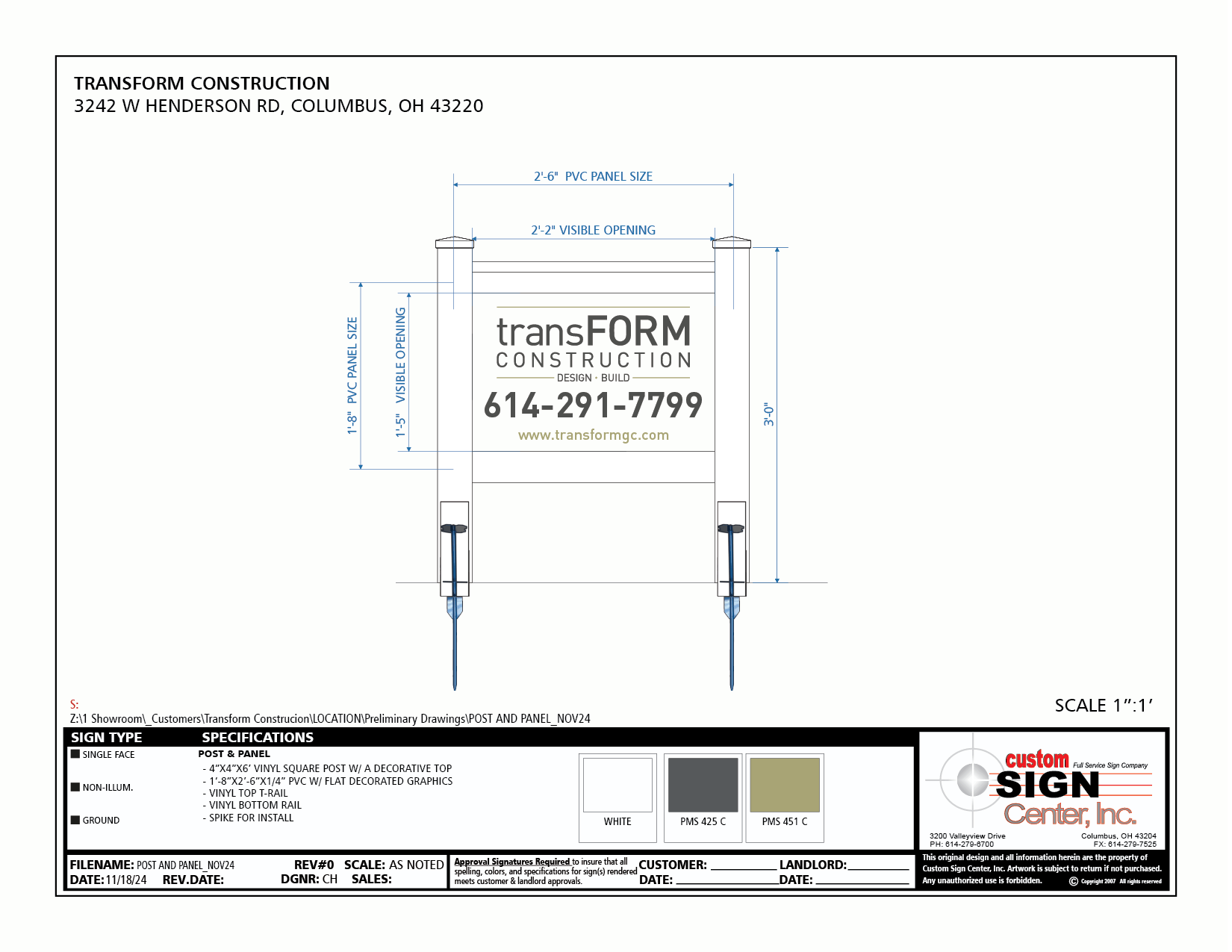
Design proof showing layout, dimensions, and branding before fabrication begins.
Every decision here has a purpose:
- Size
Bigger isn’t always better—but too small is always a problem.
The sign has to match the environment and be readable before someone drives past it. - Materials
PVC, aluminum, acrylic, illuminated components—each comes with trade-offs in durability, cost, and appearance.
The right choice depends on how long the sign needs to perform and where it’s going to live. - Branding
Colors, fonts, logo placement—this is where consistency matters.
A sign should feel like an extension of the business, not an afterthought. - Viewing Distance
This is the one most people underestimate.
If your audience is moving at 45 mph, you don’t have time for clutter or tiny text.
Clarity wins. Every time. - Zoning Considerations
And then—the reality check.
Local regulations can dictate size, height, lighting, and placement.
A great design still has to pass inspection.
This stage is part creativity, part engineering, and part strategy.
Because the best signs don’t just get noticed—
they get understood… instantly.
↑ Back to top
Permits and Approvals
Here’s where the pace changes.
Up to this point, everything feels like forward motion—ideas, designs, decisions.
Then permits enter the picture… and suddenly, you’re on the city’s timeline. Click to check out the full permit-to-install process
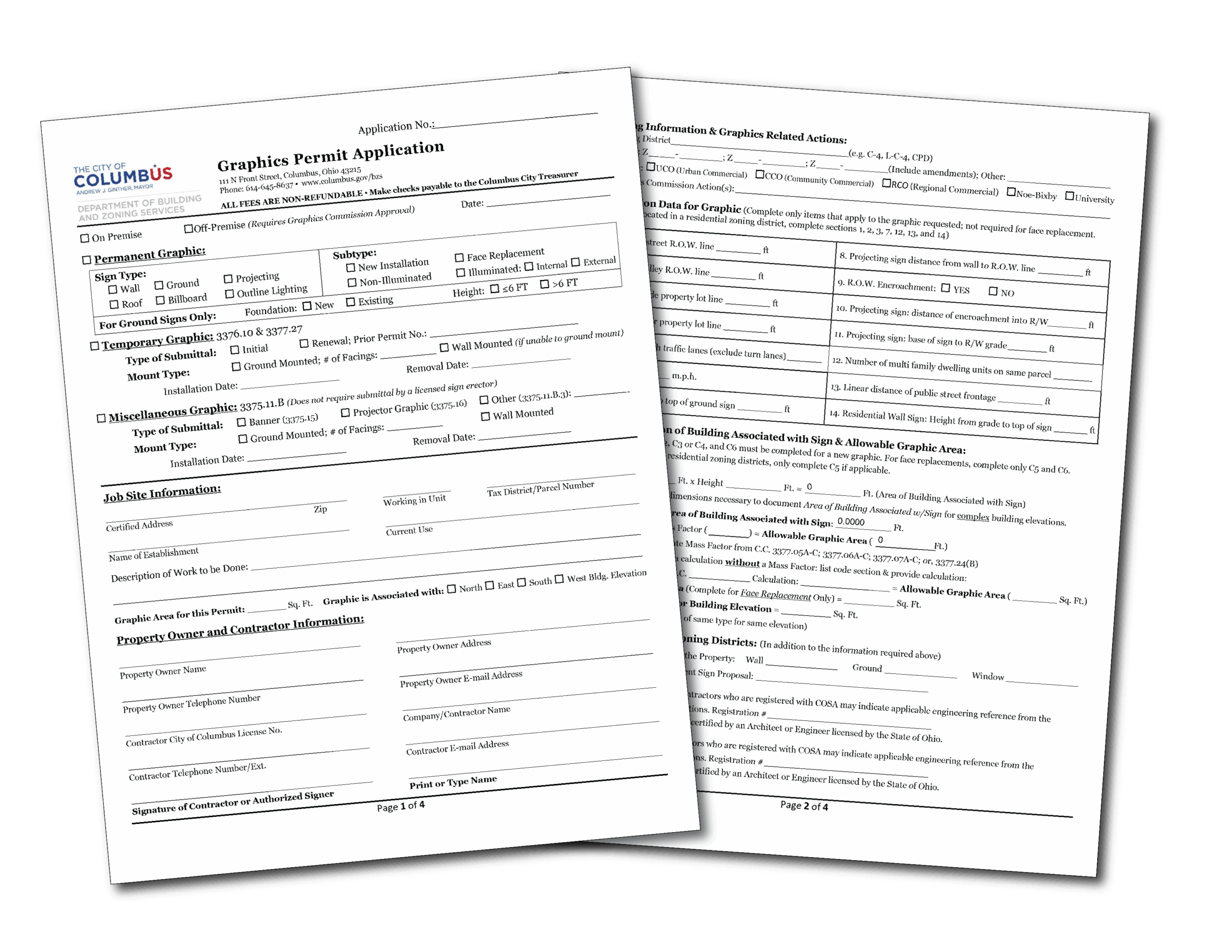
Excerpt from the City of Columbus Graphics Permit Application required for commercial signage approval.
Most municipalities have strict guidelines around signage, including:
- Height – How tall the sign can be
- Lighting – Whether it can be illuminated (and how)
- Placement – Where it sits on the building or property
- Square footage – How much visual space you’re allowed
And they don’t just take your word for it.
This stage often requires:
- Scaled drawings
- Site plans
- Structural or electrical details
- Formal applications and revisions
If something doesn’t meet code?
It gets kicked back.
That’s why this is where many projects stall—not because anything is wrong, but because compliance takes time.
It’s not flashy work.
But it’s the gatekeeper.
Because until the permit is approved…
that sign isn’t going anywhere.
↑ Back to top
Fabrication Begins
This is where the plan leaves the screen… and hits the shop floor.
No more concepts. No more approvals.
Now it’s execution.
Raw materials come in one side—
finished signage starts taking shape on the other.
Here’s what that looks like in real terms:
- Material Preparation
Sheets are selected, staged, and prepped—PVC, aluminum, acrylic—whatever the job calls for.
This is where quality starts. Bad material = bad outcome. No shortcuts. - Cutting Panels
Precision matters here. CNC routers and cutting tables shape panels to exact specs.
If it’s off even slightly, everything downstream feels it. - Printing Graphics
Large-format printers bring the design to life—colors, logos, messaging.
Then comes laminating and finishing to protect it from sun, weather, and wear. - Welding
Structural components are built to support the sign—especially for larger installations.
This is strength you don’t see… but absolutely rely on. - Electrical Components
For illuminated signs, wiring, power supplies, and lighting systems are integrated and tested.
Because once it’s installed, it has to work—first time, every time.
This stage is equal parts craftsmanship and process control.
It’s where experience shows.
It’s where problems get solved before they ever reach the field.
And when it’s done right?
Installation becomes the easy part.
↑ Back to top
Installation Day
This is the moment the world finally sees.
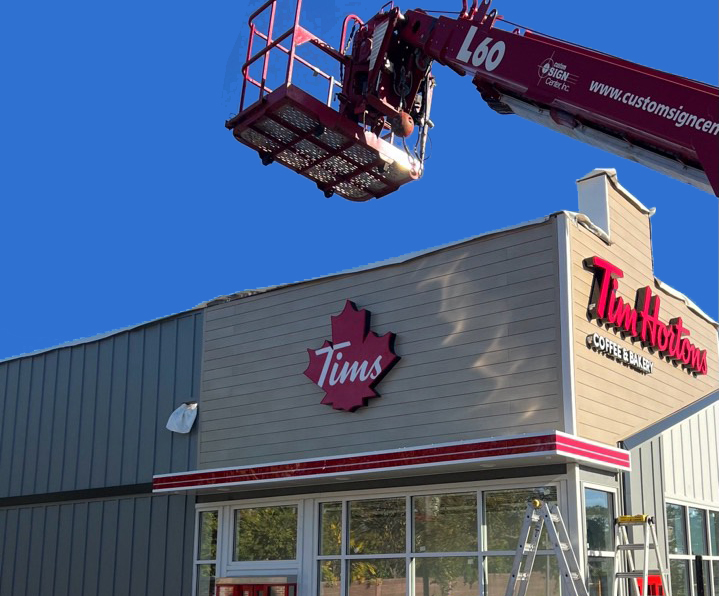
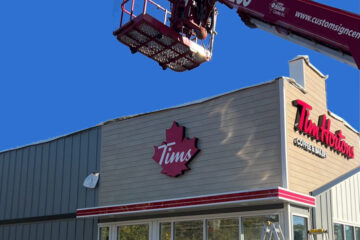
Channel letter installation in progress at a Tim Hortons location in Columbus, Ohio.
After weeks of planning, approvals, and fabrication—
everything comes down to a few critical hours on-site.
Trucks pull in.
Equipment gets staged.
And suddenly, that empty space starts turning into something real.
Here’s what’s happening behind the scenes:
- Cranes or Lifts
Depending on the size and placement, bucket trucks or cranes are used to safely position the sign.
Big signs don’t forgive small mistakes—everything is controlled and deliberate. - Site Prep
Mounting locations are checked, surfaces are prepped, and hardware is set.
This step ensures the sign isn’t just installed—it’s secure for the long haul. - Electrical Hookups
For illuminated signs, power is connected and tested.
Clean wiring, proper connections, and code compliance all matter here. - Alignment
This is where craftsmanship shows up in plain sight.
Level. Centered. Balanced.
Even a slight tilt can throw off the entire look.
And here’s the truth most people don’t realize:
If installation is rushed or sloppy,
everything that came before it loses impact.
But when it’s done right?
The sign looks effortless—like it was always meant to be there.
And that’s exactly the point.
↑ Back to top
Long-Term Maintenance
Here’s the part most people forget:
A sign doesn’t stay perfect on its own.
Day after day, it’s out there taking the hit—sun, wind, rain, dirt, temperature swings.
And over time, even the best-built sign starts to show it.
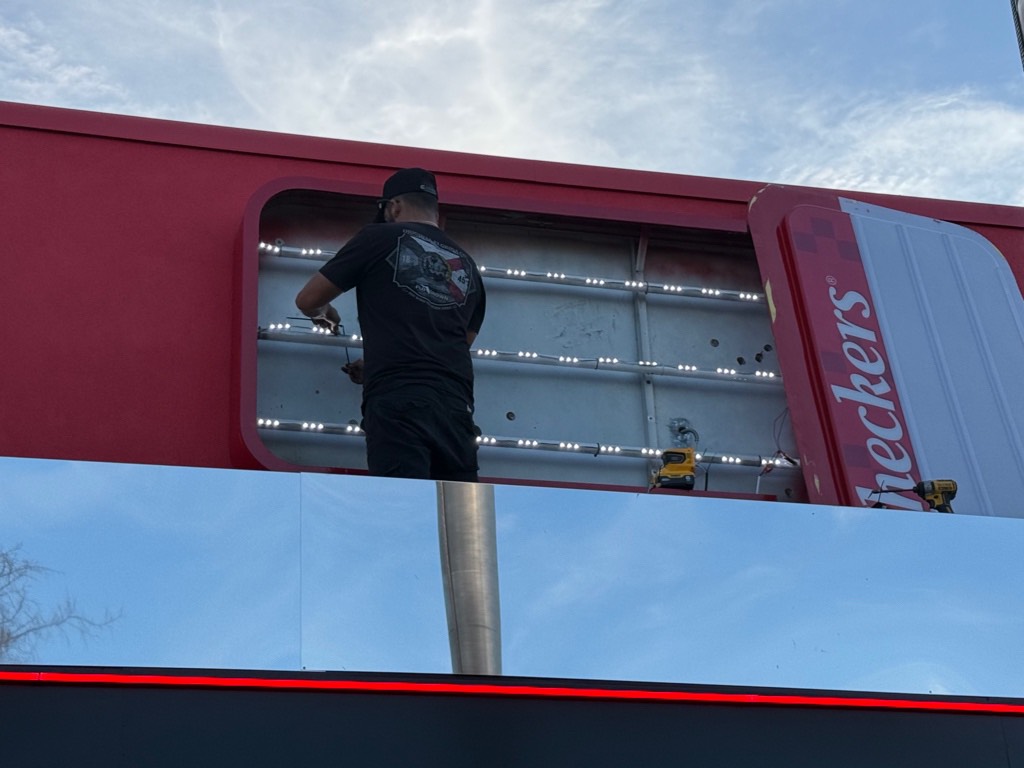
Proper installation and maintenance ensures all signs are safely assembled, illuminated correctly, and built to perform long term.
That’s where maintenance comes in.
Not as a repair…
but as a strategy.
- Cleaning
Dirt, dust, and pollution build up faster than you think.
A simple cleaning can bring a sign back to life almost instantly. - Lighting Repair
Burned-out LEDs or electrical issues don’t just dim the sign—they dim the business.
Consistent lighting keeps everything looking open and operational. - Repainting or Refreshing Graphics
Colors fade. Materials age.
A refresh keeps branding sharp and consistent with how the business wants to be seen. - Panel Replacement
Damage happens—weather, accidents, time.
Replacing panels is often faster and more cost-effective than starting from scratch.
The businesses that stay ahead of this?
They don’t let their signage quietly decline.
They maintain it like any other critical asset.
Because a well-maintained sign doesn’t just last longer—
it keeps working like it’s supposed to. Read more about sign maintenance in our Sign Maintenance Tips blog post
↑ Back to top
Conclusion
It Was Never “Just a Sign”
By the time a sign goes up, the real work is already behind it.
The idea was shaped.
The details were engineered.
The approvals were earned.
The materials were cut, printed, built, and tested.
And finally—installed with precision.
What looks simple from the outside is anything but.
A commercial sign is one of the few business tools that works around the clock—quietly attracting attention, guiding customers, and reinforcing your brand every single day.
But it only works that way when every step is done right.
From the first thought to long-term maintenance, it’s a process built on experience, coordination, and craftsmanship.
So the next time you see a sign go up?
You’re not just looking at a finished product.
You’re looking at the result of an entire system—
working exactly the way it was meant to.
↑ Back to top

0 Comments